Showing posts with label 1944. Show all posts

Thursday, July 2, 2026

The Canterville Ghost (1944)

Sir Simon de Canterville (Charles Laughton), called to defend the honor of his brother, chickens out. For his cowardice he is walled up inside the castle. His spirit will never become free until one of his descendants does something brave in his name. Unfortunately, all of his descendants are also cowards. It’s World War II and an American army unit is being housed in the once-grand Canterville castle. I wonder if one of those brave Yanks is a Canterville.

Six year old Margaret O’Brien plays Lady Jessica. She seems especially brave, but apparently curses are strictly misogynistic. O’Brien was very memorable in Meet Me in St. Louis that same year. As an adult she almost completely transitioned to television. Curious how she would have fared as a Hollywood leading lady.

It's very curious how the film clearly outlines the problem to be solved and the conditions that must be met to solve it. Because of this we are not surprised that G.I. Cuffy Williams (Robert Young) has the exact same birthmark as our spirit. That was the classic Hollywood version of 23 and me. Reginald Owen (A Christmas Carol) plays Sir Simon's less than forgiving father and Rat Packer Peter Lawford is his undefended brother. Una O'Connor has a disappointingly small role.

I’m certain I’ve confused this film with A Canterbury Tale more than once. Both were released in 1944, set in rural England, and involve the US Army. Not sure the Nazis were actually operating in rural England, but both films say otherwise. That said, the films aren’t terribly similar. This is a very Hollywood production while A Canterbury Tale is, well, not.

Based on an Oscar Wilde story, it has been adapted a great many times, twenty eight by my count. This appears to be the earliest. I know little of the source material, but I do know that sir Simon was guilty of far more than just failing to defend his brother's honor.

The Canterville Ghost isn’t a bad watch, but predictable and unimaginative. AMRU 3.

Saturday, May 23, 2026

A Canterbury Tale (1944)

A US Army sergeant (John Sweet) on his way to the English city of Canterbury accidentally gets off the train one stop too early, where he meets a British sergeant (Dennis Price) and pretty Alison (Sheila Sim). When some man puts glue into Alison’s hair, the three are determined to track him down.

The title is a reference to The Canterbury Tales, a fourteenth century collection of stories by Geoffrey Chaucer. Director Michael Powell grew up just outside the city and this film is his love letter to it. There is an ancient road that pilgrims used centuries ago to travel to Canterbury, where they would receive blessings. This is important, because our heroes are modern day pilgrims, apparently, even though they aren’t actually going to Canterbury for much of the film.

All three leads were unknowns, none more unknown than Sweet, an actual sergeant in the US Army with no acting experience. Other than a short released the same year, this was his only screen credit. His lack of acting skill was quite evident. Alison, as was actress Sim, is in the Woman’s Land Army, a program to place women on farms to replace men who left for the war. She and Sergeant Johnson cross paths with characters that feel like they will become part of the story, but don’t.

A Canterbury Tale begins as a detective story, then becomes something different. I have high expectations for a Powell/Pressburger production, especially one as revered as this. It does feature some excellent visuals (black and white in academy aspect, as it is), but initial audiences didn’t quite know what to make of the film. I seem to be in their camp. Perhaps a second viewing. AMRU 3.

Sunday, April 27, 2025

Phantom Lady (1944)

Handsome engineer Scott (Alan Curtis) goes out on the town alone and meets a pretty woman (Fay Helm). She agrees to accompany him to a show but insists they don't exchange names. When he returns home he finds that his wife has been murdered. When nobody seems to remember his unnamed alibi, the cops finger him for the murder.

This is that rare noir whose protagonist is female, the plucky and decidedly non-fatal Carol (Ella Raines). She is sweet on her newly single boss and never questions his innocence. Old Friend Elisha Cook Jr makes an appearance as a cool-daddy-o jazz drummer. His drumming was so good that they would make sounds even when he wasn’t striking them. This makes our eleventh visit.

For about a year prior to starting this blog I watched a large number of old films, this being one of them. I was mostly unimpressed back in aught-8 but always intended on returning to it. Finally I have and I think I regarded it a little better. When Carol gets closer to our mystery lady she is referred to as Miss Terry. That's pretty amusing. 

Phantom Lady is a fairly well-regarded if somewhat forgettable noir. It also has a serious plot flaw that nagged at me for much of the film. I’ll say no more on that, but it’s not mentioned in the IMDb Goofs section. That said, I'm definitely glad I revisited this film. AMRU 3.

Monday, December 9, 2024

Going My Way (1944)

A young and carefree priest (Bing Crosby) is assigned to be assistant at the troubled St. Dominic’s Church, but his methods run afoul of father Fitzgibbon (Barry Fitzgerald). I wonder if music will somehow solve the church’s problems.

Recorded a year ago under the impression that it was a Christmas movie (it is not), I watched it early because my cable provider is deleting stuff off my DVR. I will rant on this during my year end wrap up. A friend of Bing’s Father Chuck is Genevieve, star of the New York Metropolitan Opera. She is played by Risë Stevens, star of the New York Metropolitan Opera. Would-be church for-closer is played by Gene Lockhart.

There is an interesting situation where the neighbors, police, clergy, and landlord all become suspicious of a young woman’s life arrangements. At eighteen she essentially ran away from home to become independent, but her moral turpitude comes into question. Won’t some decent man make an honest woman out of here? By which I mean a housewife. This is just one of those prevalent social conventions that disappeared by century’s end.

Going My Way does not appear to have too much going for it, but you become dragged into their world. Father Chuck’s earnestness, Father Fitzgibbon’s quirkiness, and the people who surround them are all very engaging. It’s little surprise that the film won … seven Oscars?!?! Ok, that is a little surprising. In addition to Best Picture, it earned statues for both Bing and Barry, director, original story, screenplay, and song. Fitzgerald was nominated for both lead and supporting actor.

Accolades aside, it's an excellent film and a very pleasant watch. You are caught up in the story and are left satisfied. AMRU 3.5. But it’s no Double Indemnity and certainly no Laura.

Sunday, December 27, 2020

Meet Me in St. Louis (1944)

The Smith family lives in idealistic 1903 St. Louis, but that doesn’t mean they don’t have problems. Serious problems like how can Ester (Judy Garland) get the boy next door to propose if they haven’t even been introduced? And can sister Rose get her boyfriend to propose over that new-fangled tele-phone contraption? Also, where has Tootie buried all of her dead dolls?

Meet Me in St. Louis is a nostalgic, feel-good, high production piece of fluff. Therefore, it was a huge success. The big song is Judy’s Have Yourself a Merry Little Christmas which, unlike the others, has real meaning in the story. Here also is where The Trolly Song comes from, later made famous by the Sweeney Sisters.

The inciting incident comes past the halfway point. With a variety of personal issues in play, dad announces that they will move to New York City. Why live in a gorgeous Victorian in picturesque St. Louis when you can live in a Manhattan tenement? It’s a great opportunity, after all. Everyone must come to terms with this change while celebrating their last Christmas in St. Louis. This is the context of Judy’s song. Tootie doesn’t respond well.

Mary Astor plays Mom and she was hard to recognize, both in appearance and manner. Marjorie Main (Ma Kettle) played the maid. She wasn't hard to recognize. June Lockhart and Hugh Marlowe had tiny roles, but we must talk about Tootie.

Margaret O’Brien at 6 was already an established child star, so her momager decided the studio should pay her accordingly. The studio immediately responded by announcing that the part would go to the daughter of an electrician. The O’Brien’s held out and ended up with the contract they wanted. The electrician responded by dropping lighting equipment from a catwalk near where Margaret was standing. Hollywood is such a warm and inviting place.

The investment in O’Brien certainly paid off for the studio. She just about steals the show and was awarded a juvenile academy award. The same movie framed around her character would have been very interesting. The Halloween segment was, well, quite unexpected. The kids of the town are left to their own devices where they build a bonfire with stolen patio furniture, and throw flour in the face of adults they hate. The talk of hate and blood and murder from the youngest two Smith daughters was delightfully out of place.

But this is Judy’s film and a big hit for her, despite her hairstyle looking like she is hiding horns. And her acting ... wasn’t terrible. Perhaps the lack of gravity in her performance was masked by the mannered style of period costume dramas. The film has only slightly more realism than Oz. Her difficulty on set is an early example of the pill problem that would eventually take her life. At 22 the lines in her face were starting to appear. In the end she pulled out some pretty good performances and would go on to marry the ugly director, twice her age.

Meet Me in St. Louis is the kind of film that it is. Everything is perfectly lit, the colors supersaturated, and all characters, regardless of the circumstance, are impeccably costumed, styled, and made up. But the morbidity of the two youngest sisters is shockingly out of place. Out of place, but oddly not unwelcome. Were it all glitzy confection, it would have less appeal. As such, AMRU 4. It is a delightful piece of fluff.

“It'll take me at least a week to dig up all my dolls in the cemetery.”

Friday, August 21, 2020

Cry of the Werewolf (1944)

The estate of a lady werewolf is now a museum based on her legend. When her tomb is located her gypsy daughter is determined to protect it. Oh, and she’s a werewolf too.

Taking a cue from Son of Dracula they set the story in Louisiana, but still gave it an Eastern European feel. Nobody spoke with a southern accent and they wore winter clothes inside and out. It was December, but it still felt out of place.

The story centers on the son of the museum curator and a pretty museum worker from Transylvania. Gosh, they sure do make a cute couple. They are trying to solve the mystery of the professor’s death. And so are the cops. They have trouble putting it all together despite having all the clues handed to them. Suspicious people act suspicious.

I wanted to like Cry of the Werewolf. I really did. I wish I could edit the script while watching to fix the dialog and straighten the story out. It wouldn’t have been that hard. But it could have used more than a little tinkering. We know all the secrets early on. There is no mystery, no ambiguity, and it's a shame. I think the filmmakers simply didn’t want to ask much from the audience. We got them into the theater, why make them pay attention?

Clearly there was no budget for makeup and special effects. The wolf transformation is simply a dissolve from the shadow of the Gypsy Princess to that of a medium sized dog. Couldn’t even afford a big dog. And don't get me started on the rubber bands. On the plus side, Nina Foch was very good as the Gypsy princess trying to protect her mother’s grave. She went on to a long, successful career, so don’t feel bad for her.

As I said, I wanted to like this film, but it felt like the film didn’t want to be liked. An atmospheric werewolf story set in a spooky museum and a gypsy camp has promise for a B horror film, and the performances were pretty good. But clumsy dialog and an underdeveloped story sabotaged this effort. AMRU 2.5.

Sunday, December 8, 2019

Dark Waters (1944)

Pretty young woman (Merle Oberon) survives a u-boat attack that killed the rest of her family. She has no one to stay with despite apparently being fairly wealthy now. As luck would have it an aunt and uncle she’s never met live on a plantation not too far from the hospital. An overly helpful doctor offers to take her there and check in on her constantly. Things are not as they seem! Or they are?

I have a better film on my DVR. But it was late and I didn’t want to watch a two plus hour movie. So, instead I found something on Amazon Prime that was only 89 minutes, after twenty minutes of searching. Smart, aren’t I? Dark Waters sounded like an interesting film-noir. Wrong on both counts.

Merle Oberon is a rather enigmatic leading lady. Quite pretty, somewhat exotic, and a pretty good actress, but her films are mostly forgettable. After Wuthering Heights (1939), none of them have more than a few thousand votes on IMDb. 1939 was a bad year for your best film. Despite playing the delicate flower (why does a rich woman in her 30’s need relatives to stay with?) she was charming and had chemistry with her obligatory romantic partner.

The cast was rounded out by Elisha Cook, Jr. (playing an Elisha Cook, Jr. type) and Thomas Mitchell (speaking of 1939) as Uncle’s business partner. Both great character actors that always seem to find their way into great films. And films like this. I presume Merle was playing a woman much younger than herself making our creepy doctor's behavior seem even worse as he looked every bit of his 40 years plus a few.

Dark Waters (not to be confused with Dark Waters, or Dark Waters, or even Dark Waters) is labeled film-noir but it’s not really. It has some of the elements but in actuality its just a crime drama. I wasn’t expecting a “good” film but I did have higher hopes based on the cast. But it’s the film that lets the cast down. The audio and video quality could have been better but the main flaw is the pacing. Scenes drag as the director beats us over the head with the “good guy is good” message. Certain elements didn’t make sense, like, “what the hell is the plan?” When you spend an hour and a half on a small story the audience should not be left guessing. Also, they treat a lamp briefly going out then back on like a paranormal event. They are in a house, deep, deep in the bayou, during world war 2. Faulty wires anyone? The real mystery is how they have electricity in the first place.

I watched it, liked the performances, and was left disappointed. If they cut ten minutes and wrote a more satisfying ending, you might have something there. As is, AMRU 2.5.

I will not fear long movies, I will not fear long movies, I will not fear long movies ...

Sunday, September 29, 2019

The Scarlet Claw (1944)

Holmes and Watson are in Quebec listening to a lecture on the occult by Lord Penrose. The small Canadian town of La Mort Rouge where the Lord is from has a folk tale where people and livestock were mysteriously killed, their throats ripped out. The Lord takes an important phone call and learns that his wife was murdered in exactly the same way. He uses this fact to thumb his nose at that smug skeptic Sherlock.

Penrose doesn’t want Holmes snooping around but Sherlock received a letter from the deceased asking for his help, so he investigates. There are many suspicious characters in this small town and Holmes (Basil Rathbone) and his trusted assistant Dr. Watson (Nigel Bruce) are on the case.

There are a couple ways The Scarlet Claw resembles The Hound of the Baskervilles, which is actually mentioned early in the film. The primary being where a murderer uses old legends to cover his crimes -- OH I’M SORRY DID YOU THINK REAL GHOSTS AND MONSTERS WERE AT PLAY? MAYBE I SHOULD HAVE ISSUED A SPOILER WARNING! -- There are other similarities but I shan’t share.

What makes this episode slightly better and recent ones is that you don’t actually know who the bad guy is, and there are many suspects. One complaint I do have is that Holmes doesn’t seem terribly adept at preventing additional murders, arriving just after the nick of time.

Hey, look! It’s Ian Wolf! That guy was in everything … blah blah blah. I also recognized the name Kay Harding, but she was only in one other film I saw, another Sherlock. She was only in seven films.

You know, I’m starting to feel sorry for Watson. Sure, he’s full of bluster. He overshares in front of suspects, stumbles around, and here gets stuck in the mud. But he’s a real doctor (even gets to do some actual doctoring this time), is fiercely loyal, and always answers the call. Here he was twice referred to as Holmes’ “assistant” and is teased by Sherlock himself. Just not fair. Let’s give good old John Watson, MD some credit, shall we?

This episode lands on a higher note than the previous. It had atmosphere, excellent character performances, and real mystery. AMRU 3.5.
“Aw, what you need is more faith and less imagination!”

Friday, September 22, 2017

The Pearl of Death (1944)

Sherlock Holmes (Basil Rathbone) learns that notorious thief Giles Conover intends to steal the famous Pearl of Death (think Hope diamond except it’s a grey marble). And through his bumbling (you heard me right!) Conover manages to do just that. Conover ditches the pearl before being apprehended and our heroes try to locate it before the bad guys do.

One of the better episodes, but not a solid mystery in the traditional sense. The only real mystery was where Conover hid the pearl, and we were in the process of figuring that out fairly early. Still, a better story and me sleeping through the midsection is no reflection on it.

Evelyn Ankers plays the bad guy’s blond helper chick. She did a lot of Universal during the 40’s. She was the love interest in The Wolf Man, Elsa Frankenstein in Ghost of, and also in another Sherlock flick. Sadly, she would turn 40 and have to retire. Now I turn your attention to prolific character actor Ian Wolfe.

Ian Wolfe played the elderly shopkeeper, doctor, councilman, whatever in just about everything. If you don’t immediately recognize him then get yourself checked for face blindness immediately. He has over 300 acting credits, more than half feature films. This is the seventh film of his I’ve covered here and has appeared in a bunch more I should see, and also another Sherlock flick. Fourteen of his films were nominated for best picture with three winning. He played different characters in two episodes of Star Trek. He started doing TV in the late 40’s and continued until the late 80’s. His last film was Dick Tracy at age 94. Seriously, he was in everything.

The Pearl of Death (no Sherlock Holmes and ...) provides a fair amount of mystery along with the regular elements we have come to expect. I would be negligent if I didn’t admit that I am growing a little tired of the series, but on the whole they are solid entertainment. AMRU 3.5.
“If it isn't, I shall retire to Sussex and keep bees.”

Thursday, August 25, 2016

Lifeboat (1944)

A ship is sunk by a German U-Boat and survivors assemble onto a remaining lifeboat. A torpedo also downs the U-Boat and one of the survivors is a Nazi. How can this crazy, mixed up family learn to get along?

Here we have an eclectic cast in a very confined space. Americans, Brits, and a Nazi. Engine room grunts, a socialite, a negro, a millionaire, a crazy person, Gilligan, the Skipper, and a Nazi. A few conflicts, mysteries, and deaths. I will give nothing away. Did I mention there was a Nazi? Well, that’s kinda a spoiler, I guess.

Socialite reporter Tallulah Bankhead lived an interesting life. She started in Hollywood but didn’t get far. So she became a hit on the London stage. Tried and failed again at Hollywood, then took Broadway and the New York social scene by storm, She returned to Hollywood at forty and made Lifeboat. Her unconventional style and open sexuality earned her fans and detractors. Her Hollywood career didn’t last and her last role was as Batman villain Black Widow.

The set for Lifeboat was tall to make room for the water, and actors had to climb a ladder to get into the boat. It was noted that Tallulah did not wear underpants, Hitchcock reportedly remarked "I don't know if this is a matter for the costume department, makeup, or hairdressing." Maybe apocryphal but amusing nevertheless.

Longtime readers may remember William Bendix from Blue Dahlia, or Henry Hull from Werewolf of London, or Walter Slezak from The Inspector General, or maybe Hume Cronyn from,well I guess nothing I’ve seen so far. He was in several films on my must-see list. He effected a terrible cockney accent hard to forget. Amazing cast of character actors, reminiscent of 12 Angry Men. And written by John Steinbeck to boot!

Lifeboat is a survival story and a character study. I find early Hitchcock to be inspired but somehow flawed. An exaggerated ending or otherwise unpolished. Lifeboat is Hitch at the prime of his career, on the verge of greatness. Thrilling throughout and way better than I expected. AMRU 4.

Sunday, October 4, 2015

Mademoiselle Fifi (1944)

Pretty seamstress Elizabeth (Simone Simon) shares a coach ride with a variety of upper class people during the Franco-Prussian war. When a German officer called Mademoiselle Fifi (yea, the strapping dude played by the dashing Kurt Kreuger had a lady's name - that wasn't properly explained) holds up the coach until she dines with him, the others at first support her defiance. When they realize how much their business interests suffer by her defiance, they convince her to "Dine with" him. She dines with him but the others assume that she "dined with" him, but in reality she just dined with him. They are cold to her when the coach is allowed to continue.

At her destination also arrives the new priest. The old priest would not ring the church bell out of defiance to the Germans. The officers make all the pretty seamstresses wear "lady of quality" dresses so that they can have a party with them. At first Elizabeth defies them but she is convinced by the others that they will lose their jobs if she does not go.

Based on a Guy de Maupassant story (as was the basic premise of Stagecoach), this is a story about people standing up to a threat even though their personal interests are in jeopardy. Something not lost on 1944's France. In the original story Elizabeth was no seamstress and she totally "dined with" Fifi, nudge nudge. Also, the fifi nickname was an implication that he preferred to dine with men.

Hey, look, Batman's Alfred! He was also in Cat People. Also, Jason Robards' father. Lots of contract players here.

This movie hit my radar because it A) was produced by Val Lewton, B) was directed by Robert Wise, and C) starred the adorable Simone Simon. While the sets were excellent and it was wonderfully directed, it was something of a snoozer. Maybe the story resonated better during the war.

Glad I saw it, held my interest, won't see again. AMRU 3.

Thursday, October 30, 2014

The Uninvited (1944)

Brother and Sisters (Ray Miland and Ruth Hussey) purchase a beautiful mansion on the seacoast for great price. It's cheap because it's haunted.

What follows is a mystery punctuated with some genuinely spooky scenes. The former owner's granddaughter desperately wants to visit the house even though grandpa says it's dangerous. The history of the house, slowly pieced together, helps explain the occurrences and direct the course of action.

TCM host Ben Mankiewicz pointed out that the golden age of Hollywood produced few quality Ghost/Haunted House movies. Most that they did were comedies. The Uninvited stands alone as a quality, serious ghost movie.

Batman's Alfred has a key role. Remember him from The Mole People? The IMDB entry includes the keywords closeted and suspected Lesbian. I presume they are referring to the Ruth Hussey character, but I think they are reading too much into the unmarried sister angle.

What does come off as odd is when 40ish Miland starts hitting on 20ish granddaughter. Pretty-pretty Gail Russell battled a few ghosts of her own. Alcoholism gripped her life and she succumbed to a heart attack at age 36.

Atmospheric, well acted, and a complex story, The Uninvited is a very well crafted film. The story creeps without relying on jump-scares or feeling manipulative. It has the feel of a costume drama-period piece, without actually being one, but I don't hold that against it. I wouldn't object to a second viewing, but I'll settle on AMRU 3.5
"We will do nothing tonight that the priest wouldn't approve of."

Tuesday, May 20, 2014

Gaslight (1944)

Ten years after the unsolved murder of a singing diva, her hot young niece (hot young Ingrid Bergman) moves back into the stylish London house where it happened, with her new husband (Charles Boyer). A dashing detective (dashing Joseph Cotten), stunned by the niece's resemblance to her aunt, reopens the cold case.

Gaslight is based on a play (Gas Light, or Angel Street), and had already been made into a movie four years earlier. Under the terms of the agreement, the producers ordered the destruction of all prints of the previous film. They failed to get them all, and the 1940 version has lapsed into the public domain. I saw it next.

Gas lights, that is, the lighting mechanism where natural gas was piped into houses for lighting purposes, certainly plays a large role in the story. Not only do they pepper the screen with shots of men lighting them, they even play into the story. Our protagonist becomes convinced that someone else is in the house because the lights dim, as if someone lit one elsewhere. They also add great ambiance and all gothic horror movies should have had them rather than foolish candelabras and sometimes even electric lights, totally ruining the mood. Had they not been expensive, and occasionally suffocate people, burn down houses, and even blow them up, they'd be a great addition to any home! Act now, supplies are limited!

I learned a few things from watching this movie. First, that I am actually capable of saying the words "Angela Lansbury was hot". What a naughty bit of crumpet, she was! At 17 she quit her job in a local shop and launched her movie career. Secondly, and more importantly, I learned that I apparently have absolutely no friggin' clue what film-noir is. I'm classifying this sucker as a mystery (although not a terribly mysterious one). Melodrama, sure. Entertaining and well made movie, you bet! Film-noir? Doesn't smell like it to me. There is a detective and an element of claustrophobia, but hard boiled, pessimistic, and minimalist? It's set in the fashionable district of Victorian/Edwardian London. You know, the stuff dreams are made of. AMRU 4.
"I knew from the first moment I saw you that you were dangerous to me."
"I knew from the first moment I saw you that you were dangerous to her."

Sunday, March 11, 2012

Double Indemnity (1944)

Walter Neff (Fred MacMurray) pays a visit to a client who's car insurance is about to expire. The Mr. Dietrichson isn't home but Wally likes what he sees with the Mrs. (Barbara Stanwyck). Eventually the Mrs. floats the idea of life insurance, in case anything unfortunate happens to the Mr. Of course the Mr. mustn't ever found out he bought it. Well, Walter smells a rat. And he likes what he smells. Together they plan how the insurance gets bought and how accidents can happen.

The fly in the ointment is Walter's boss, the savvy Mr. Keyes (Edward G. Robinson). You see, he has a "little man" that tells him something is fishy. Apparently Keyes' "little man" is a bit smarter than Neff's.

Excellent acting, great dialog, engaging story, Double Indemnity earned it's reputation as a great film. IMdb ranks it 55th all time (currently) and in the genre of film-noir it's third. I put a rush on watching it because Starz was making a hasty exit from the land of netflix, and while I enjoyed the movie, I can't say I love it up to it's reputation. I'll give it a 4.

So, what's the buzz about the movie? Apparently director Billy Wilder and co-screenwriter Raymond Chandler hated each other. Wilder would later say he flaunted his "womanizing ability" to torment the closeted Chandler. Wilder also had Stanwyck wear an ugly blond wig to give her a cheap, fake look. Later a studio exec remarked "We hired Barbara Stanwyck, and here we get George Washington".
"How could I have known that murder could sometimes smell like honeysuckle?"

Tuesday, January 10, 2012

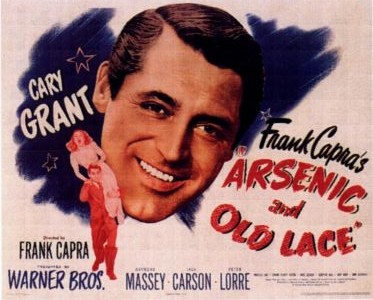
Arsenic and Old Lace (1944)

Mortimer Brewster (Cary Grant) is an author and avowed bachelor for life who finds himself married. Before his honeymoon he rushes to visit his favorite aunties to break the news when he finds that they have been busy poisoning people and burring them in their basement. To complicate matters, his bully of an older brother (Raymond Massey) shows up running from the law, with a body of his own.

Based on the play, Arsenic and Old Lace stays fairly true to it's theatrical roots. The movie, almost in it's entirety, takes place in one room. Witty dialog, good acting, fast pace, it was an enjoyable watch.

What was interesting was how self-referential it was. In one scene in a grave yard, Grant is near a stone that reads Archie Leach, his real name. Massey's character underwent cosmetic surgery to hide from the authorities, but his doctor (Peter Lorre) made the mistake of making him look like Boris Karloff, who during filming was playing that character in the Broadway play. And in another scene Mortimer is mocking how people act in plays while the exact same situation happens around him. To tell the truth, I found it a little irritating.

Worth seeing, even if Grant hated his own performance. AMRU 3.5.
Elaine Harper: But Mortimer, you're going to love me for my mind, too.
Mortimer Brewster: One thing at a time!

Friday, November 25, 2011

House of Frankenstein (1944)

Or, Frankenstein Meets the Wolf Man 2.

Not really, but almost. The evil doctor Niemann (Boris Karloff) and his faithful assistant Igor ... I mean Daniel (J. Carrol Naish) escape from prison, commandeer a travelling circus, and head for Visaria in order to take up the good doctor Frankenstein's work. Said circus also happens to feature the bones of Dracula (John Carradine), which if you take the stake out, his evil body reappears.

While searching for Frankenstein's notes in his demolished mansion, they stumble across the body of the Monster (Glenn Strange) and the Wolf Man (Lon Chaney Jr). Stop me if you heard this one before. Anyhow, Niemann promises Daniel a proper body so that he can woo this hot gypsy chick, promises to keep Dracula's coffin safe during the day, and promises Wolfie that he will kill him. Instead, the douche, he totally uses his new circle of friends to work on his real project: getting the monster back to full strength and killing the people who sent him to prison. And what would a Frankenstein flick be without Lionel Atwill in there someplace. Once again, he plays an inspector.

So, Karloff took a break from Broadway to appear in the movie, but apparently Lugosi wasn't free. Seems he took up Boris' role. Therefore, Carradine becomes a lackluster Dracula. And speaking of which, what, was he in the movie a whole four minutes? The only reason I can imagine for his appearance is to make the movie poster more crowded with monsters and to introduce him for the next movie. I understand there was a thought to include The Mummy as well, but that would have been ridiculous.

A few interesting points: As this movie mostly takes place in "Visaria", which sounds like "Vasaria" where Ghost Of was set, the evil doctor house is that of the other brother's, and he was the least evil of all the Frankenstein's. Nobody from the actual family appears, unless you count the Monster. George Zucco had a small part as the circus owner. I had to go online to find out what role he played. It was all too brief. And, Chaney, Strange, and Naish all died in 1973. Chaney and Naish's collective last movie was the schlocky Dracula vs. Frankenstein, which I totally have to watch.

Thirteen years after the advent of Universal's reign as the king of horror, we are seeing their demise. The appearance of a large, slow moving creature isn't enough to scare audiences anymore and compensating with a monster mash has limited appeal. There is one more, however, but I will explore that with the Dracula line. Eventually.

Despite this, I actually found House Of to be a bit of a rebound for the franchise. It was fun. Doesn't touch the early work, but every bit as good as Son Of. AMRU 3.5.

Saturday, August 27, 2011

Curse of the Cat People (1944)

The makers of Cat People got together and said "That seemed to have worked. Let's do a sequel." But instead they made a different movie and called it Curse of the Cat People.

The principle actors are back but now the story surrounds little Amy. She's a strange girl who doesn't play with the other children and believes in a fantasy world. Mom and Dad grow concerned. Amy befriends a crazy old shut-in, talks to ghosts, and is watched over by calypso singer Sir Lancelot. I won't say more lest I spoil the original. I'll say this, though. Ollie never does learn to act.

Curse of the Cat People has no cat people and, in my estimation, no curse either. What it does have are nuanced scenes and good atmosphere. But there is little to confuse with the original. Or horror movies in general. It's a thriller, I suppose, but despite elements of the supernatural, not horror. It falls short of the original, but still well worth watching. AMRU 3.

Tuesday, February 22, 2011

Charlie Chan in the Secret Service (1944)

Netflix recently made suggestions based on my interest in Charlie Chan in the Secret Service. Oh, yea, I thought. I saw that. I forgot to blog about it. Talking about staying power ...

Sidney Toler is back as America's favorite Asian stereotype. I've already covered the racism aspect of these films so let's take that as read. Thanks for building our railroads. We really appreciate it. As it turns out my criticism of the lack of clues leading to the conclusion from the first one holds true for this as well. Toler, in his annoying Chan cadence, points out clues he could not possibly have known. Everyone is a suspect until the very end. You have no chance of figuring it out yourself, except maybe to suspect the one person they don't highlight very much.

Here's how the story goes: scientist murdered, secret government plans stolen, dinner party guests suspects, Chan solves. Yawn.

This one was made earlier than Scarlet Clue and as it turns out, the first to feature my old friend, Mantan Moreland. Benson Fong also lends his uselessness to the mix. Chan niece Iris also tags along. Played by Marianne Quon, she was ... kinda cute. She didn't do a whole lot of acting in her life, and not that much here as it turns out.

Now I've seen two of these things and one thing is clear. A comedy/mystery that is neither funny nor a good mystery doesn't make for much of a movie. I liked Scarlet better because Mantan's bits were better. Having seen it first may have helped as well. AMRU 2.

Thursday, July 15, 2010

To Have and Have Not (1944)

Ernest Hemingway didn't think his book could be translated into a movie. He was right. Director Howard Hawks instead made a movie with his book's title and similar characters. I don't hold that against him. I never read the book and very little Hemingway in general.

Bogart is Captain Morgan. Not THAT Captain Morgan, just A captain Morgan. Steve Morgan. Or Henry Morgan. Whatever, it doesn't matter. He takes rich people and his drunkard friend (Walter Brennan) out for fishing trips. To complicate this heaven on Earth, Nazis, the resistance, and a hot chick enter his life. Basically, Casablanca with a slightly different setting.

Morgan doesn't want to get involved with the resistance, but he is short on cash. He acts tough guy, woos the chick (Lauren Bacall), and makes them Nazis pay. Typical of what we expect from the man.

 Not much more to say, really. Enjoyable. Not as good as Casablanca, but still good. AMRU 3.5.

Wednesday, February 10, 2010

Laura (1944)

Several weeks ago I picked up Laura and watched about two thirds of it before it failed. I tried cleaning it without success. It wasn't due yet, but I took it back to the library hoping they could quickly run it through their cleaning machine. There was a hold on it, so instead they checked it in. The library itself had placed the hold for the purpose of maintenance. I went out of my way to select a different copy to request. Several weeks later, it arrived. I'm certain it was the exact same copy. Not flawless, but I watched it uninterrupted, with my youngest son.

Laura (Gene Tierney) is dead. Murdered in her own apartment. Dana Andrews is Detective Mark McPherson. He first interviews fussy newspaper writer Waldo Lydecker (Clifton Webb) and learns a little about Laura. The two then visit Laura's would-be fiancee, Shelby Carpenter (Vincent Price) who is staying with Laura's aunt (nudge nudge, wink wink). Waldo does not like Shelby.

Through the investigation we learn that Laura was a singular individual. Beautiful, charming, talented, kind, she had it all. We wonder who could want to kill her while we learn that each suspect has a possible motive. Then, the story twists, making us reevaluate all we have learned.

Wittier than expected dialog, great acting, and a top notch story, it's hard to find fault with Laura. Webb's Waldo in particular has some great lines:

"I don't use a pen. I write with a goose quill dipped in venom."
"In my case, self-absorption is completely justified. I have never discovered any other subject quite so worthy of my attention."
"It's lavish, but I call it home."
"I should be sincerely sorry to see my neighbor's children devoured by wolves."
Price, too has some great ones:
"I don't know a lot about anything, but I know a little about practically everything."
"I can afford a blemish on my character, but not on my clothes."

The Providence Library will be showing Laura later in the month and had this disk failed, that's where I would have been. In fact, I may still. Laura was awesome. AMRU 4.5.

Gene Tierney was hot.