Showing posts with label Peter Lorre. Show all posts

Friday, February 10, 2023

Stranger on the Third Floor (1940)

Reporter Michael testifies against a man (Elijah Cook, Jr.) found at a murder scene. The suspect had threatened the deceased. Later, Michael finds himself in a very similar situation, and is now the suspect. It’s up to his pretty fiancee to prove both murders were committed by a mysterious stranger (Peter Lorre) only he saw.

I recently learned that this film is considered the first example of film-noir, and TCM was kind enough to air it a few days later. It wasn’t a critical or financial success, the style being a bit of a departure from mysteries and crime dramas of the day. It was called pretentious and artsy, an unusual reaction for an RKO B picture. It featured the desperate and pessimistic attitude, and expressionistic lighting of later noirs, and an extensive dream sequence.

Ethel Griffies, who was our hero’s cantankerous landlady, played the elderly ornithologist in The Birds some 23 years later. His neighbor is played by prolific character actor Charles Halton, who appeared in 174 feature films, 108 in a six year span between 1937 and 1942. He must have jumped from set to set shooting his scenes quickly then moving on. He has appeared in everything from classics to forgotten B pictures. He worked until he was 82, then died at 83. He needed the rest.

Peter Lorre was very Peter Lorre playing the Peter Lorre role. He had little screen time but was quite good. Elijah Cook had a surprisingly small role. Heroine Margaret Tallichet was quite charming, but having married director William Wyler, would retire a year later.

Perhaps the real villain was the criminal justice system, too quick to rush to judgment. Too eager for a conviction, truth be damned. Our hero learns this only when the shoe is on his foot. Also, he is kind of a jerk. Pretty Jane should think twice before marrying him. Stranger on the Third Floor does have a strange tone. Maybe a bit pretentious. Still, it’s interesting, and Peter Lorre is fun to watch as a demented killer. AMRU 3.

Monday, March 23, 2020

All Through the Night (1942)

Crooked sports gambler ‘Gloves’ Donahue (Humphrey Bogart) learns that the baker of his favorite cheesecake has been bumped off, so he decides to investigate. Mostly because a hot chick is somehow involved. He uncovers a bigger conspiracy. Could it involve Nazis? Yes. Yes it could.

Could this be a highly rated (7.1 on IMDb) Bogart film-noir that I had never even heard of? That sounds too good to be true. Sadly, it is. Released between The Maltese Falcon and Casablanca, All Through the Night is principally a comedy. This explains how Phil Silvers and Jackie Gleason got invited to the party. Still, the story plays out as a crime mystery/drama. Everyone’s favorite uncle William Demarest plays sidekick Sunshine whose major contributions are cracking wise and knocking stuff over.

Additionally, Casablanca alumnae Conrad Veidt and Peter Lorre have principal roles. Freaks star Wallace Ford has a smaller role. Our femme fatal stand-in is played by Kaaren Verne (Ingeborg Greta Katerina Marie-Rose Klinckerfuss to her friends). Three years after the film’s release, she and Lorre divorced their respective partners and hooked up for five years of marital bliss.

Bogart at this time was a star but not yet a legend. He plays a tough, but lacks the cynicism of his better roles. Remember, he is motivated by hot chicks and cheesecake. There isn’t much mystery here. Bad guys coerce good people to do their bidding. Why? We learn soon it’s because Nazis and World War II. So many B pictures in the early part of the war tread this ground. All Through the Night is no different, and little better. It keeps your interest well enough, and Bogart raises the level of any production, but it is what it is. An unfunny comedy, a film-noir with little atmosphere, a mystery with little mystery, a crime film that doesn’t take itself serious. Just a movie that holds your attention. And Humphrey Bogart. AMRU 3.

Saturday, January 27, 2018

The Beast with Five Fingers (1946)

A crippled pianist is murdered after it is learned that his will was changed so that his nurse will inherit the bulk of his estate. As the will is being contested, it appears his disembodied hand is trying to kill again.

Creepy mansion? Check. Old time setting? Check. References to the occult? Check. The Beast with Five Fingers takes itself fairly seriously, even if its audience doesn’t. It’s a fairly atmospheric throw-away horror film that successfully gets the viewer an hour and a half older in a not unpleasant manner. The filmmakers wanted Paul Henreid (Casablanca) for a key role, but he wisely declined. Sources disagree what role he was to play but IMdB says Peter Lorre but I'm guessing it was the Robert Alda part.

Not too much to say. Some mystery, a love triangle, decent special effects for the day, and good atmosphere. Just don’t expect to be wow’d. AMRU 3.

Wednesday, July 27, 2016

The Man Who Knew Too Much (1934)

Clumsy and awkward, even Hitch himself said it was the work of a talented amateur. The 1956 remake is much more polished and Hollywood-ized causing many to prefer the original. You’ll hear my opinion after I see the remake. And you read it out loud. Because, you know, voices. Like many films that fall into the public domain, the audio and video quality suffers. I turned the sound all the way up and tolerated the pop and hisses. Also, I had some difficulty following which character was which. It became easier once that person was shot. Oh, spoiler alert.

The story, in a nutshell, is a family is on vacation and befriend a man who turns out to be a spy. He is shot and quickly tells mom about some super secret information in his hotel room. Dad finds it but British intelligence and bad guys are wise. M5 pressures mom and dad to give up the info but they won’t because the baddies have kidnapped their annoying little girl. So, Dad becomes an amateur sleuth to save the day.

Man, a little over the top with the British politeness thing. Lot’s of “Terribly Sorry” and “Not quite”’s of pre-WWII England. Not a mystery, exactly, because we pretty much know who the bad guys are. We don’t know their plan, but I must admit I’m not sure I recall what it was even now. This was Peter Lorre’s first English speaking role. When he met with Hitch he smiled and nodded through the meeting because he didn’t understand English. He learned his lines phonetically.

When comparing this film with his own 1956 remake he said this was “the work of a talented amateur and the second was made by a professional." Clearly rough but somewhat charming and definitely British, the second was a Hollywood production through and through. The Man Who Knew Too Much was likable but forgettable and sometimes hard to follow. Unless you find a copy of a fully restored version, consider skipping it. AMRU 2.5.

Wednesday, October 21, 2015

Mad Love (1935)

The famous Dr. Gogol (Peter Lorre) becomes infatuated with the star of a macabre theater production. When he reveals his affection for her, she reveals she's married to the famous pianist Orlac (Colin Clive). The good doctor then reveals how creepy he can be.

Later, Mr. Orlac's hands are crushed in a train accident and the doctors cannot save them. Yvonne begs Dr. Gogol to help, but he fails as well and instead transplants the hands of an executed murdered.

Peter Lorre was, at least in his early years, a truly wonderful actor. He is obsessed but does not start out to do evil. He tries to save the hands of Yvonne's husband to prove his love, then descends into madness. This is his first American film and his performance rivals his from M.

Ted Healy, of Stooge fame, has a small role as a reporter. His reckless mishandling of the Stooges forced them to give him the heave-ho. Alcoholism and a piss-poor attitude resulted in him getting his ass handed to him a bar fight in 1937, death resulting. Colin Clive, also a drinker, died that same year.

The impact of many of the climactic scenes may be credited to director Karl Freund. A prolific and highly respected cinematographer, it has been asserted that it was his camera artistry that saved a very troubled Dracula production. He also has Metropolis on his resume.

Mad Love is a well made, lesser known gem. The story, while not overly complex, offers some clever twists. I found myself thinking back on it for quite a while. I will see it again. AMRU 4.
"Each man kills the thing he loves."

Tuesday, January 10, 2012

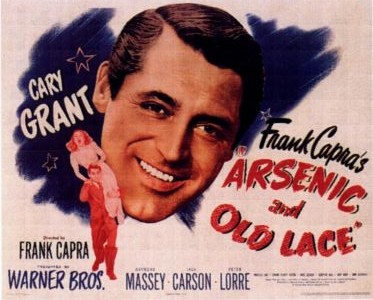
Arsenic and Old Lace (1944)

Mortimer Brewster (Cary Grant) is an author and avowed bachelor for life who finds himself married. Before his honeymoon he rushes to visit his favorite aunties to break the news when he finds that they have been busy poisoning people and burring them in their basement. To complicate matters, his bully of an older brother (Raymond Massey) shows up running from the law, with a body of his own.

Based on the play, Arsenic and Old Lace stays fairly true to it's theatrical roots. The movie, almost in it's entirety, takes place in one room. Witty dialog, good acting, fast pace, it was an enjoyable watch.

What was interesting was how self-referential it was. In one scene in a grave yard, Grant is near a stone that reads Archie Leach, his real name. Massey's character underwent cosmetic surgery to hide from the authorities, but his doctor (Peter Lorre) made the mistake of making him look like Boris Karloff, who during filming was playing that character in the Broadway play. And in another scene Mortimer is mocking how people act in plays while the exact same situation happens around him. To tell the truth, I found it a little irritating.

Worth seeing, even if Grant hated his own performance. AMRU 3.5.
Elaine Harper: But Mortimer, you're going to love me for my mind, too.
Mortimer Brewster: One thing at a time!

Saturday, March 13, 2010

Tales of Terror (1962)

In a similar vain as 1963's Twice Told Tales, Vincent Price stars in three stories "inspired" by Edgar Allen Poe. While I've read very little from Nathaniel Hawthorne, Poe and I go way back. The three stories are The Black Cat, which isn't one of my favorites, The Case of M. Valdemar, which I never read, and Morella, which I never heard of. First up is Morella.

Young hottie Lenora (groan) visits dad (Price) who lives in an spooky mansion with cob webs and spiders. Where else would Price live? Lenora discovers mom resting in bed, which is a bit of a shock as she died when Lenora was an infant. Oh, and still blames her for her death.

Next is The Black Cat. Peter Lorre is an old, fat, drunk, layabout who is abusive to his wife. Despite this, his wife is fairly young and kinda hot. While about town he stumbles into a wine tasting being hosted for a famous and renowned wine taster (Price). Lorre proceeds to challenge him to a competition. Here, Price is about as gay as you've ever seen him, although he does use proper wine tasting mouth techniques, don't ask me why I know that. Being a notorious lush prepares one for so few things in life, but apparently one is to be a great wine critic. Lorre and Price strike up a friendship and Lorre brings him home to meet his young, under appreciated, and neglected wife.

The writers decided to combine the story with The Cask of Amontillado, a story I liked much better. Price's character is name Fortunato and they even sample some Amontillado.

The final story is The Case of M. Valdemar, which is based on The Facts in the Case of M. Valdemar. Price is a dying man and the only person who can temporarily relieve him of his pain is a mesmerizer (Basil Rathbone). Hot hot hot daughter doesn't like the good doctor and doesn't trust him, but daddy does and that's all that matters. What the doctor wants to do is mesmerize Price at the point of his death to see what happens. Oh, and to nail his hot daughter, but who wouldn't. Unfortunately for everybody, she marries a Chinese millionaire shortly after filming and retires from acting.

Roger Corman directed it while taking a break from doing absolute garbage. Somewhat darker than Twice Told Tales, I found them a little more entertaining and even handed. The sets seemed a little less cheesy. Price, Lorre, and Rathbone reunite in 1963 to do a parody called The Comedy of Terrors. Lorre would do two more undistinguished movies, then the man so amazing in M would pass from this Earth a couple months from his 60th birthday.

I liked it and so did my boys. AMRU 3.5.

Friday, January 29, 2010

Beat the Devil (1953)

On display at the library was a Bogart film I wasn’t familiar with. It stars an aging Bogie, a plump Peter Lorre, and a very young Gina Lollobrigida. It was directed by John Huston and written by Huston and Truman Capote. With that many big names attached to this film, I reasoned, it has to be great. Or suck.

The movie also featured the hot Jennifer Jones, who died in December, and Robert Morley, who looked at death’s door during the movie (fatty managed to live almost another 40 years). The clincher for me was to see a 26 year old Lollobrigida.

“Adventure at its boldest! Bogart at his best!” Bigger lies never before graced a movie jacket cover. Loosely based on the James Helvick novel, Bogie is Billy Dannreuther (sounded like Dan Rather), a man of questionable past married to Lollobrigida. He has a business deal with a group of four criminals lead by Peterson (Robert Morley). Somehow they will swindle uranium rich land in Africa and become millionaires. Bogie has the contact. They are delayed in Italy where they meet a British couple. He is a stuffy aristocratic type, she a dizzy chick with a strange sense of humor. They are taking over a coffee plantation and are on the same steam ship. Lots of antics in town and on board.

Jennifer Jones was charming, delivering the strangest lines in rapid fire. Bogie was, well, Bogie. Older. He would live only four more years. He was in a car accident during filming and lost a couple teeth, so then-unknown actor Peter Sellers was hired to dub parts. Lorre had a fairly small role.

I kept waiting for the business to get going. The trip, the land grab, the millions, but this is a standard caper-gone-bad film. Once I realized the story I THOUGHT was going to unfold, wasn’t, I enjoyed it a bit more. Lots of side deals, obstacles, lies, and mishaps. The tone was light, like a comedy, but it was more tongue-in-cheek than LOL. Still, it kept me interested, and guessing. Were I to pass it while channel surfing, I would likely linger on it for a bit, but I can’t imagine watching it again. AMRU 3.

“I've got to have money. Doctor's orders are that I must have a lot of money, otherwise I become dull, listless and have trouble with my complexion.”

Wednesday, September 16, 2009

M (1931)

Someone is abducting little girls and murdering them. Peter Lorre is Hans Beckert, a "rehabilitated" mental patient, who is frustrating the police. No material evidence is ever found and witnesses disagree on every detail. The police, in desperation, spend every night raiding every night club and harassing every two-bit crook.

The crooks have had enough. They band together to find the culprit so that they can get back to their businesses of picking pockets and other petty crimes. I'm going to stop right there. Anything more would be spoiling the film, and with M, I actually care.

I picked up M because in the category of Film-Noir, IMDB rates it number 3. 48th overall. I didn't know what to expect. M is a truly remarkable film.

Lorre's performance was nothing short of stunning. Earlier in the film, he'd be on screen and you'd say "oh, yea, totally a child molester". He just had that look. His big scene at the end is unbelievable. Truly out of this world.

I don't have anything sarcastic to say. I'm lost for snark! It's disorienting. Here's what I learned about Fritz Lang. Fritz was a German movie director principally remembered for Metropolis (1927). M, he felt, was his best work. When the Nazis took over in Germany, he fled. He continued to make movies in Hollywood, none matching the power and impact of M. He had the reputation of being demanding of actors, to the point of abuse. But, what did he look like? Think Colonel Klink, but more gay.

That's the stuff! In striking contrast to every other movie I've gotten from the library, this one was perfect. Not only was the restoration flawless, the disk itself was pristine. No skips! I must see this movie again. AMRU 4.

Saturday, August 29, 2009

Casablanca (1942)

I've seen this film once or twice before, so I knew I loved it. I got it on DVD last Christmas. Yesterday, I watched it again.

Rick (Humphrey Bogart) is the owner of a saloon with a mysterious past. The leader of the Czech underground and Nazi thorn Victor Laszlo (Paul Henreid) arrives with his unbelievably hot wife, Ilsa (Ingrid Bergman) trying to find passage to America. The local authorities, Captain Renault (Caude Rains) and the Nazis want to keep them in Casablanca. Rick can help, but will he?

It seems back in Paris (Flashback! - Doo doo doo, Doo doo doo, Doo doo doo), Ilsa and Rick met up just before the Nazis rolled into town. Ilsa thought Victor was dead, so she made plans to run off with Rick. At the last minute, she learns Victor was only MOSTLY dead, so she leaves Rick at the alter/train station. Poor Rick.

Back in Casablanca, Rick has a choice to make. Help Victor because he sympathizes with his cause or set him up and take his unbelievably hot wife?

Here are a couple of my observations after this viewing:

Sidney Greenstreet and Peter Lorre had very small roles, smaller than I remember. Ingrid Bergman was unbelievably hot. Had I mentioned that before? Claude Rains has many great lines. Clearly a womanizer, but look at these:
"Well, Rick is the kind of man that... well, if I were a woman, and I were not around, I should be in love with Rick."
and
"She was asking about you earlier in a way that made me very jealous."
I know he was supposed to be French, but come on! What's going on here? Discuss ...

Casablanca is an all time great film. Great acting, writing, and atmosphere. It's even better than it's reputation. And Ingrid Bergman was unbelievably hot. AMRU 5. I hope to convince my sons to watch it.

Sunday, May 31, 2009

The Maltese Falcon (1941)

This adaptation of a Dashiell Hammett novel stared Humphrey Bogart, Mary Astor (remember her from Red Dust? She's not hot in this film either.), Peter Lorre, Sydney Greenstreet, and also featured Eliza Cook Jr (from just about everything). Directed by John Huston. Arguably, this is Bogart's most famous role after Casablanca. 

Sam Spade and red shirt Miles Archer are detectives. Stereotypical bombshell walks into their office with a hard luck story. They take the case, and soon Archer is dead. Different groups of people turn to mess with Spade, who slowly pieces the real story together. Everyone has a back story and everyone is searching for a jewel-encrusted falcon statue, painted black to disguise it's real value. Who gets it? With all the smoking going on in this film, a black lung was more likely than a black bird. It says something about cigarettes when obese Greenstreet outlives Bogart and Lorre by more than ten years. Cook, it should be noted, lived to a ripe old 172. 

The American Film Institute ranked this the 31st greatest movie of all time in 2007, then called it the 6th best in the genre of Mystery. It was nominated for Best Picture, Best Supporting Actor, and Best Screenplay. 

With the marquee names and reputation, I have to say this was a bit of a let down. I enjoyed the movie, but I couldn't make heads or tails of the story. I think I'll need to watch it again. This time without child interruption. AMRU 3.5.