Friday, August 19, 2022

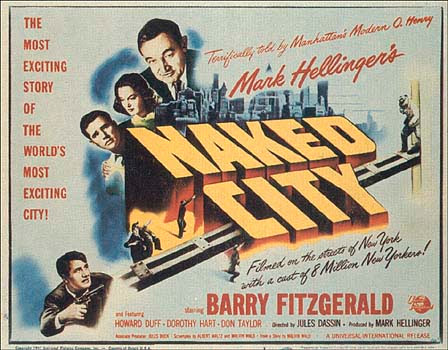
The Naked City (1948)

A pretty young woman is found drowned in her bathtub, with signs of a struggle. This is a case for the homicide department of New York City’s 10th precinct.

Everyone’s favorite leprechaun Barry Fitzgerald is Lieutenant Muldoon. He, along with Detective Halloran and others, work the case. They follow leads, question suspects, and do research. You know, police work. It’s worth noting that actual police work was quite the novelty in 1940’s Hollywood.

I had turned on TCM half way through an unfamiliar noir. A good noir, I thought, would really scratch the itch, so I hunted through my DVR for a candidate. I found The Naked City. Although labeled film noir by IMDb, it really isn’t. No hard boiled attitude, no expressionistic lighting, no femme fatal. It’s a police procedural, and a pretty good one.

While not what I was looking for, The Naked City is a very interesting watch. We don’t know much more than the detectives, so it serves as a better than fair mystery. And it’s a realistic case. The earth isn’t in the balance, just a murder that needs to be solved. There were likely a few in the city that summer. Some elements are more flick than fact, much of the ending in particular, but it remains a solidly realistic depiction.

The Naked City spawned a TV series of the same name, and inspired many others in the years since. It won't rock your world, but the story is deceptively complex and will definitely hold your interest. AMRU 3.5.

"There are eight million stories in the naked city. This has been one of them."

Thursday, August 11, 2022

Sh! The Octopus (1937)

Two dopey police detectives learn that the new police commissioner is targeting a criminal organization called The Octopus, which they confuse as being the real animal. A frightened woman has them travel to an island lighthouse during a storm for some cockamamie reason. A painter is staying at the lighthouse expecting it to be a quiet place to work. An assortment of other strange characters file in.

This film is complete nonsense. We are teased with some semblance of a story early on, but that goes out the window pretty quickly. Characters come and go without explanation, action happens without purpose, and the final reveal does little to satisfy. While it is not uncommon in some light comedies for the story to be nothing more than a framework to hang comedic bits off. Here, there is only a set piece and a basic premise for that purpose. And the comic bits aren’t funny.

The movie is memorable for one thing. A character transforms from normal looking into a witch-like appearance. This is achieved using special makeup and red and blue light filters. It was used in Dr. Jekyll and Mr. Hyde (1931) and is quite effective. It would only work in black and white and I am surprised it wasn’t used more often.

Detective Kelly was played by Hugh Herbert and has a distinctive voice and mannerisms. I haven’t seen him in a film before but I am certain I’ve seen him characterchured in a Warner Brothers cartoon. He was teamed with Allen Jenkins for the first and only time.

SH! The Octopus really is a mess. Story elements are introduced, then never mentioned again. It appears characters are included simply because actors under contract needed work. They were asked to quickly create a character and run with it. Thing is, though, the movie seems to be based on a play. I'm sure a lot of foolishness was thrown during filming.

It's unclear how this movie got onto my radar, perhaps it was the visual effect, but it was quite skippable. That said, it was short and despite it all, held my interest. AMRU 2.5.

Saturday, August 6, 2022

Fear and Desire (1953)

Four soldiers crash miles behind enemy lines and formulate a plan to get back to safety. They experience a lot of fear, but also desire.

Stanley Kubrick’s first feature film is a surreal affair. Mostly because of its very low budget, it has an abstract and stripped down feel. Two of the unnamed enemies were played by two of the main characters. This saved Kubrick from having to hire two more actors and also gave it a “they are us” feel. And as no nation or geolocation is ever mentioned, they might actually be us. Financed by Stanley’s uncle, the film was shot silent and dubbed by the actors in post.

Our four heroes are the pilot, Lieutenant Corby, Sergeant “Mac” who resents his fly-boy superior what with all that fancy book learning, and still wet behind his ears Private Sidney, who is not prepared for what lies ahead. Oh, and private Fletcher is there too. This also features the first film role for Virginia Leith, whom old friends will remember as Jan in the Pan.

The twenty four year old Kubrick produced, directed, filmed, edited, and even did sound design here, and his inexperienced hand is apparent. Some edits are very clumsy, likely caused by a lack of coverage. The dialog is clunky and philosophy heavy. And some character interactions implied more story that did not come. The film lost money, uncle refused to provide any more loans, and Stanley hated the finished product so much he tried to have every existing copy and negative destroyed. Apparently he failed.

Fear and Desire is a short, somewhat interesting film but is inescapably amateurish. Kubrick was said to have “absolutely loathed it” and called it a “bumbling amateur film exercise". It is not without some interesting elements, but were it not for the name attached to it, it would be entirely forgettable. AMRU 2.5.

Sunday, July 31, 2022

Belle de Jour (1967)

A beautiful young wife (Catherine Deneuve) with a fear of intimacy has bizarre sexual fantasies. She can’t be intimate with her husband but decides to become a prostitute in the afternoons. Worlds eventually collide.

Not sure what I expected. Certainly not this. I mean, what a premise. The film is rife with fantasy sequences (perhaps a trademark of director Luis Buñuel, I don’t know), which adds layers of ambiguity.

So, what does it mean. Because of the fantasy sequences one could argue that some, most, or possibly all of the film is simply Séverine’s fevered dream. The ending in particular is debated, of which Buñuel himself said he didn’t know what it meant. I believe he was being a little disingenuous. He had been making films for almost forty years. He didn’t include a closing scene like that without a reason. And I have my opinions on this point.

But ignoring all that, this is a story of a very desirable woman, married to a good, handsome man who loves her. She can’t be the wife he deserves, the one she wants to be, and he is endlessly patient with her. But when she balks at her first prostitution job, the madam sees that she needs “a firm hand”. The frigid woman needs not patience and understanding, but “the rough stuff”.

Talk me down from this interpretation. Seriously. Because otherwise, Belle de Jour is a fairly charming and well made story. It is lauded for it’s Yves Saint-Laurent high fashion but for plebeians like me where fashion is meaningless, it just looks very 60’s. It’s an engaging film, but if I am right about the message, It is very problematic for me. AMRU 3.

Thursday, July 21, 2022

Trog (1970)

Amateur spelunkers discover a brightly lit cave made out of painted styrofoam. While exploring, they come face to face with the most terrifying thing imaginable: a white dude in a rubber mask. After one is killed, they flee to tell the esteemed “Dr.” Brockton (Joan Crawford), who decides she needs it for a pet.

None-too-keen on a monster chillin’ in the area is real estate developer Sam Murdock (Michael Gough) whose initial plan is to loudly make disparaging remarks about the doctor and monster to anyone in his vicinity. His strategy slowly improves.

Towards the bottom of the sciency monster flick subgenre, here the good doctor wants to save the creature while ignorant and fearful townsfolk want it destroyed. Seeing how things pan out, maybe the townsfolk were right. And if they knew her research consisted entirely of watching the creature play with toys, I think they would have lynched her in the second act.

We go from a late career revival for Joan Crawford to her very last. She agreed to this film as a favor to friend Herman Cohen, whom she worked with in Berserk. I’ve seen a couple Cohen produced films, and while none were very memorable, they were better than this.

Here we have all the hallmarks of a low budget rush job. An uninventive story with poor to terrible sets and costumes, but the highlight is the supremely awful script. The dialog was clumsy and inconsistent, and the science abysmal. Brockton states in court that Trog (short for troglodyte, or cave-dweller) is the missing link, somehow woken from a state of suspended animation after millions of years, despite the lack of any evidence.

Oddly, the acting was not a weak point. Crawford, considering what she was given, didn’t phone it in. Same for Gough even though his character was entirely one note. Even Trog did a better than fair job emoting. And he was wearing a 2001 cast-off mask in serious disrepair and fuzzy cave-man slippers. Also, I will give the movie credit for one good jump scare. 

But this does not rise Trog above the genre. The story could have done something other than follow the cheap horror boilerplate, but it had no imagination. And including an animated dinosaur clip from another film doesn’t count. AMRU 2. What a way to end a career.

Wednesday, July 13, 2022

Johnny Guitar (1954)

Vienna (Joan Crawford) runs a saloon and expects to profit greatly when the railroad comes through. But the local ranchers are none too keen on homesteading Easterners crowding out their herd. And they are none too keen on Vienna, either. She hires old flame Johnny Guitar (Sterling Hayden) for protection.

Part of Vienna’s troubles stem from her association with The Dancin’ Kid, whose gang is suspected of pulling heists. The rest stems from her reputation with the rangers, particularly feisty Emma (Mercedes McCambridge) who will stop at nothing to see Vienna and the Kid dancin’ at the end of a rope.

Categorized as an early revisionist western and a camp classic, it is the story of two strong women, the manly Vienna with a past and the angry Emma, fearful of her own sexuality. They bark orders, take action, and manipulate the simple menfolk. And if you think me harsh for calling Vienna manly, consider this quote:

“Never seen a woman who was more of a man. She thinks like one, acts like one, and sometimes makes me feel like I'm not.”

Yea, that was spoken in a 50’s western. Revisionist, indeed. Vienna knows what she wants, how to get it, and is single minded in her approach. Same for Emma who may be frightened to see herself in Vienna. It is telling that they are the only two female characters in the film, including extras.

The story elements are nothing special. We hit many of the western tropes. The ranger/farmer conflict, the posse, the gunman character, constructed around a love triangle and instigated by where choo-choo go. And from a character motivation standpoint, it makes little sense.

What elevates the film are the performances. You cannot take your eyes off of Crawford, a dozen years older than lover Hayden (and twenty years older than the Dancin’ Kid). Her performance is both absurd and captivating. So too is the dialog. Regardless of the speaker, it seemed to revolve around Vienna and her wants, and it doesn’t matter that it too makes no sense. And this is not to take anything away from McCambridge, whose wonderfully unrestrained performance is delightfully outrageous. She burns with an all consuming fire.

The Kid and his gang (which includes Ernest Borgnine from back in his thug days) hide out in a secret cabin, hidden behind a waterfall. However, the view from the cabin window shows open land for miles around. How hidden could it be? And speaking of big names in small roles, John Carradine played Old Tom, even though he was two years younger than Crawford.

There is so much to say about the story that I haven’t yet got into the story behind the story. Emma’s McCambridge (the demon voice from The Exorcist) couldn’t stand Crawford, and the feeling was mutual. Hayden was disgusted with Crawford’s unprofessional behavior and she called him “The biggest pill in Hollywood”. Director Nicholas Ray would frequently stop his car and vomit on his way to the set. Oh, and apparently François Truffaut called the movie 'The Beauty and the Beast', with Hayden being the beauty.

There are members of society that will see themselves in Crawford's performance. She's a woman in a man's world, setting the rules for the macho men in her life. But still, she can't escape society's expectations of her gender. 1950's just as the nineteenth century, as Crawford wasn't the title character. The players hated making the film, the critics panned it, and the public loved it. I kinda did too. AMRU 4.

“A man can lie, steal... and even kill. But as long as he hangs on to his pride, he's still a man. All a woman has to do is slip - once - and she's a 'tramp!' Must be a great comfort to you to be a man.”
Tuesday, July 5, 2022

Love Happy (1949)

A theater troupe struggles to finance their show (named Love Happy), jewel thieves are trying to locate a million dollar necklace they stole, and the brothers clown around. There is a lot going on, little of which is of much consequence.

This last Marx Brothers film came together somewhat accidentally. Harpo planned it as a solo project, but couldn’t secure financing unless Chico and Groucho came along. Harpo playing the Harpo character and doing all of the Harpo bits without his brothers doesn’t really make sense anyhow. Many of Groucho’s scenes appear to be filmed at a different time, improvised and poorly shot. He serves as the story’s narrator but interacts somewhat during the third act.

Vera-Ellen is charming as the plucky and lovelorn dancer. Baroness Frankenstein herself Ilona Massey is the exotic and enigmatic leader of the thieves. Her performance is peculiar but I blame the source material. Raymond Burr is one of her thugs. Marilyn Monroe had a very short and entirely gratuitous scene. That, and conspicuous product placements, may have been part of the financing agreement.

Like the worst of the Brother’s films, it transitions from a mostly uninteresting story line, to unfunny comic bits, to tedious song and dance numbers, then back again. To be fair there were a couple amusing bits, one in particular involves a handheld mirror. Unfortunately Harpo chooses to repeat it, just in case the audience was napping.

The Marx Brothers were a moment in time. Their downtrodden but irreverently upbeat act played well during the Depression, but became increasingly anachronistic as we inched towards the affluent and optimistic 50’s. Besides, only baby Groucho was under sixty at this point. It was a good time to move on.

So, this is it. The last of the Marx Brothers films. Famously Groucho omitted in his autobiography, naming A Night in Casablanca as their last. But the Brothers did appear, separately, in one more film, but I think I’m done here.

The boys did thirteen films together, but I can only recommend their second through seventh. Love Happy might be the worst of the lot, Groucho apparently thought so, and unless you feel compelled to complete arbitrary lists, it is completely skipable. AMRU 2.